The Science Behind Hands-On Writing: Why Build · Think · Create Task Cards Work
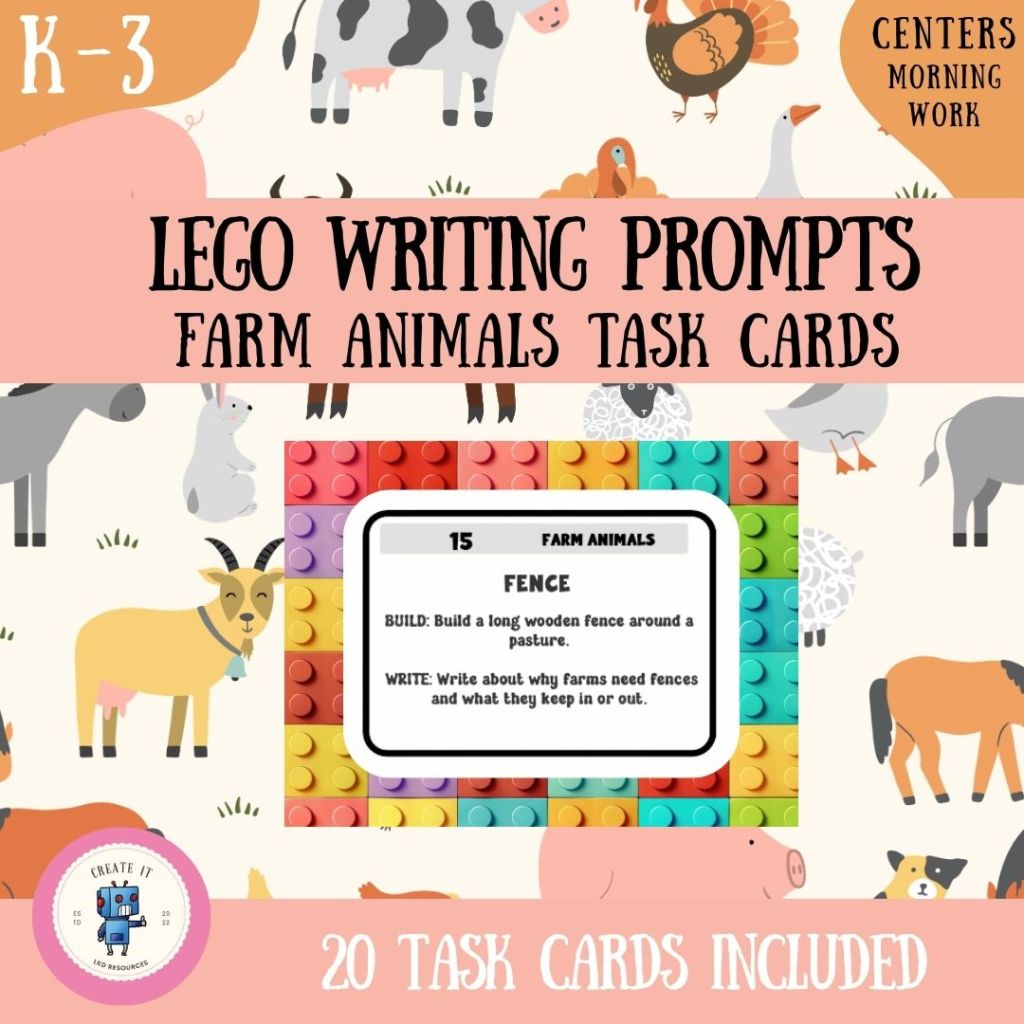
In my 2nd grade classroom in Florida, some of the strongest writing doesn’t start with a pencil—it starts with a pile of bricks and a big problem to solve. When my students use Build · Think · Create task cards to build and then write, they aren’t just “having fun”; they are engaging in a multisensory, research-backed approach to writing that supports memory, attention, and Florida B.E.S.T. narrative standards.
What Is “Hands-On Writing”?
Hands-on writing goes beyond traditional handwriting practice. It is any writing routine that intentionally blends movement, touch, visuals, and talk with the act of putting words on the page. With Build · Think · Create, that looks like:
- Students reading or listening to a task card prompt.
- Building a scene or solution with bricks, blocks, or STEM materials.
- Talking through what is happening in their build.
- Writing the story of what they created.
This type of routine is often called multisensory and embodied because it uses visual, auditory, tactile, and kinesthetic channels together to support learning. Florida’s B.E.S.T. standard ELA.2.C.1.2 asks second graders to “write personal or fictional narratives using a logical sequence of events, transitions, and an ending,” and hands-on routines give students a concrete story to organize instead of a blank page.
The Science Behind Hands-On Writing
Multisensory learning strengthens memory
Multisensory writing instruction engages multiple senses at once—eyes, ears, hands, and body. Occupational therapy and literacy resources highlight that when children trace, build, or manipulate materials while writing, they strengthen fine-motor control and create stronger memory traces for the skills they are learning. Activities such as writing on textured surfaces, forming letters or shapes with materials, and using whole-arm movements are recommended because they pair physical sensation with cognitive tasks.
When students build a rocket crash scene, talk about what happened, and then write it as a story, they are encoding the same idea through multiple channels: muscle memory, visual memory, spoken language, and written language. That layered encoding supports recall later and helps students hold onto the sequence of events they need for narrative writing.
Embodied cognition: thinking with hands and body
Embodied cognition research suggests that thinking is deeply connected to physical action—that children “think with their bodies” as well as their brains. Studies comparing pen-and-paper writing with keyboarding show that the physical act of handwriting can support letter recognition, memory, and comprehension because it activates sensorimotor systems along with higher-level cognitive processes.
The same principle applies when students build stories. When they move bricks to show cause and effect (“the rocket crashed, then we built a shelter, then we fixed the engine”), their bodies are rehearsing narrative structure: beginning, middle, and end. That embodied rehearsal makes the abstract idea of “sequence in a story” feel obvious and natural when they sit down to write.
How Hands-On Writing Supports Narrative Standards
Florida’s ELA.2.C.1.2 expects second graders to write personal or fictional narratives using a logical sequence of events, transitions, and an ending. Build · Think · Create task cards fit this standard because each card embeds a story problem that students must build and then explain.
Here’s how the science connects directly to the standard:
- Logical sequence of events
Students build their story in steps: problem, attempts, and solution. The act of physically building those stages gives them a sequence they can easily retell in order. - Transitions that make sense
As students move pieces and narrate their builds—“first,” “next,” “then,” “finally”—they are practicing the exact transition words and cohesive language the standard calls for, in a multisensory context. - Endings that resolve a problem
Engineering-style tasks are built around solving a problem (a crash, an emergency alert, an invention that must work). When students physically complete their solution, they are more likely to write an ending that actually resolves the conflict, rather than stopping mid-story. - Deeper comprehension and elaboration
Because students have handled, moved, and problem-solved their way through the story, they often have more to say on paper—details about the setting, what went wrong, and how it changed—supporting elaboration and description.
In other words, hands-on writing makes the demands of ELA.2.C.1.2 feel like recording an adventure, not completing a checklist.
Where Build · Think · Create Fits in the Day
Build · Think · Create was designed to slide into real, sometimes messy, elementary schedules. A simple 20-minute routine can fit into your ELA block, science time, or morning tubs:
- Read and discuss the card (2–3 minutes)
Read the prompt aloud so all reading levels can access it. Ask quick questions: What is the problem? Who is involved? Where is this happening? - Build the scene or solution (8–10 minutes)
Students build the rocket, space station, planet, or alien scenario described on the card, using any available bricks or STEM materials. They are naturally following an engineering cycle—Ask, Imagine, Plan, Create, Improve—as they adjust their designs. - Oral “story walk” (3 minutes)
Students turn to a partner and tell the story using their build as a visual and tactile anchor:
“First… Next… Then… Finally…” - Quick write (5–7 minutes)
Students write a short narrative (often 5–8 sentences) that matches what they just built and described. The focus: clear sequence, transitions, and an ending that solves the problem—exactly what ELA.2.C.1.2 requires.
This routine honors what research says about effective multisensory handwriting and writing instruction while staying realistic for a busy 2nd grade classroom.
Why Hands-On Writing Helps Struggling Learners
Hands-on, multisensory approaches are often recommended for students with dyslexia, ADHD, and other learning differences because they provide multiple entry points into the task. For students in low-SES communities who may carry extra stress or gaps in foundational skills, these routines can be especially supportive.
Research and practice highlight several benefits:
- More pathways for memory
Combining visual, tactile, auditory, and motor input gives students more ways to store and retrieve information. - Improved fine-motor control and automaticity
Multisensory handwriting and building tasks support hand strength, control, and fluency, freeing up cognitive energy for thinking about ideas instead of letter formation alone. - Higher engagement and reduced avoidance
When the first step is “build something cool” instead of “write a paragraph,” many reluctant writers step into the work more willingly and stay with it longer. - Natural differentiation
Students can work at different levels of complexity with the same task card: simple builds and basic sentences for some, more elaborate scenes and detailed narratives for others.
For students who typically say, “I don’t know what to write,” the story is literally sitting in their hands, ready to be described.
The benefits to using task cards:
- “This center is based on multisensory writing, which combines movement, touch, and visuals with writing to strengthen memory and fine-motor skills.”
- “It also draws on embodied cognition, the idea that children think with their bodies as well as their brains. When they build the story first, they understand it more deeply when they write.”
- “The routine is designed to support Florida B.E.S.T. ELA.2.C.1.2 by helping students write narratives with a clear sequence, transition words, and real endings—not just random events.”
About the Author
Lisa Decker is a 2nd grade teacher in Florida who teaches in a low-SES community and believes students learn best by building, talking, and creating—not just memorizing. She designs Build · Think · Create task cards to turn hands-on problem solving into standards-based writing, with a special focus on students who learn best when they can move, touch, and see their thinking.
FAQ
Can I use this routine if I don’t have special STEM kits?
Yes. Build · Think · Create works with basic bricks, blocks, recycled materials, or simple classroom manipulatives because the power of the routine comes from the problem-solving and storytelling, not from a fancy kit.
How often should I use hands-on writing centers?
Once or twice a week is enough to build consistency without overwhelming your schedule, especially if you use the same Read, Build, Tell, Write routine each time. Repeated practice helps students internalize sequence, transitions, and endings, which are key parts of Florida’s 2nd grade narrative writing expectations.
Does this only work for strong writers?
No. Hands-on writing is often especially helpful for reluctant writers and mixed-level learners because the build gives them a concrete idea to talk about before they write. Multisensory approaches can support attention, memory, and access for students who need more than a verbal prompt alone.
How does this support standards?
Florida B.E.S.T. ELA.2.C.1.2 asks students to write personal or fictional narratives with a logical sequence of events, transitions, and an ending. When students build a problem, talk through what happened, and then write the story of the solution, they are practicing those exact skills in a concrete, developmentally appropriate way.
Can families use this at home too?
Yes. Florida’s family literacy guidance encourages reading, writing, talking, and creating together at home, and hands-on storytelling routines fit naturally into that kind of learning. A family can read a prompt, build together, talk through the story, and then help a child write a few sentences or a short paragraph.

 LKD Resources/ Learning and Teaching
Leave a comment