What Happens When Your Brightest Students Finish First — And You Finally Have Something Worthy of Them
I still remember the exact look on Todd’s face. Fifteen minutes into independent work time, done with everything, staring at the ceiling tiles like they held the secrets of the universe. Then he’d start “quietly” tapping his pencil, which was never actually quiet, which meant I’d cross the room to hand him… a worksheet. Another one. The same kind of task he’d just finished, just more of it. I watched his shoulders sag every single time, and honestly, I didn’t blame him.
I tried so many things to fix this. Choice boards. A reading corner with pillows I bought myself. “Extension” problems that were really just the same problem with bigger numbers. Some of it helped a little. None of it stuck. My early finishers didn’t need more of the same work — they needed work that respected how differently their brains were already moving.
Then one ordinary afternoon, I looked over at the bin of LEGO bricks sitting in the corner of my room — leftovers from a makerspace idea that never quite got off the ground — and a question popped into my head: what if I could combine hands-on building with the writing work I was already required to teach anyway?
That question changed how I think about every resource I design now. That’s how Build Think Create was born.
What Build Think Create Actually Is
Build Think Create is a set of task cards built around one simple idea: every single card has two connected prompts. First, a BUILD prompt — the student picks up LEGO bricks and constructs a scene, structure, or model that responds to a question or scenario. There’s no single correct build; two students can interpret the same card in completely different ways, and both can be right.
Then comes the WRITE prompt. The student looks at what they just built and uses it as a thinking anchor to write two complete sentences, starting with a sentence stem (something like, “I believe… because…”).
There are no worksheets to “get right” here — this is designed for divergent thinkers who need room to think before they write. The cards work as a writing center, an early finisher station, a gifted pull-out activity, or even a substitute lesson, since the directions are simple enough for students to run independently. Everything is aligned to ELA.2.C.3.1 (the Florida BEST writing standard), but the skill underneath — writing a complete, supported sentence — is universal no matter what state you teach in.
The bricks are the thinking tool. The writing is the evidence of that thinking.
What It Looks Like in a Real Classroom
Let me make this concrete. Picture a card from the Ethical Thinkers set. It reads: BUILD a scene showing a time when two friends disagreed about what was fair. WRITE: I believe fairness means… because…
A student pulls this card and sits down with a handful of bricks. At first, they’re just building — maybe a playground scene, two little minifigures facing off over a swing, maybe a lopsided pile of blocks representing “who got more.” But here’s what’s actually happening underneath: as their hands are moving, their brain is working through the problem. The building is the thinking, before a single word hits the page.
That physical model gives the student something concrete to point to when it’s time to write. A student who usually freezes up staring at a blank line suddenly has an anchor: “my build shows two kids and one swing, so…” The blank page isn’t blank anymore — it has a build sitting right next to it.
And for the student who finishes the actual building in thirty seconds flat? That’s where the real depth shows up. They start defending their position, wondering out loud whether fairness might mean something different to the other friend in the scene. Could both kids be right? That’s a much bigger question than any worksheet was ever going to ask.
That’s the magic. The bricks slow down the thinking just enough for the writing to catch up.
Grab the Free Direction Page
I want you to be able to try this in your own room without any guesswork, so I put together a free student instruction page — the exact direction page I use in my own writing center.
It’s a one-page, color-coded, print-and-laminate page that tells students exactly what to do: numbered steps for the BUILD and WRITE process, the writing rules spelled out (including the ELA standard), a Remember section for the details students always forget, and a self-check checklist so kids can confirm their own work before they call you over.
Print it, laminate it, and slide it into a page protector at your center tray. Students can reference it independently all year long — no re-teaching required.
Download it — it’s free, it works with any Build Think Create set, and it will save you the “what do I do next?” question approximately 47 times.
Ready to Try the Full Set?
If this sounds like something your early finishers or gifted learners need, you don’t have to build your own cards from scratch — I already did that part.
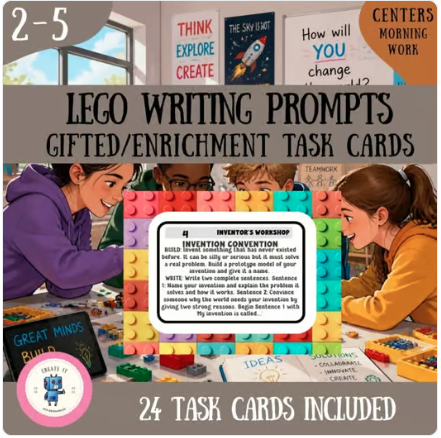
The Gifted Enrichment Set is a great place to start: an individual set with 24 cards covering six themes, including Inventor’s Workshop, Big Questions, and Change Maker, for just $5.00. GIFTED ENRICHMENT SET ($5.00)]
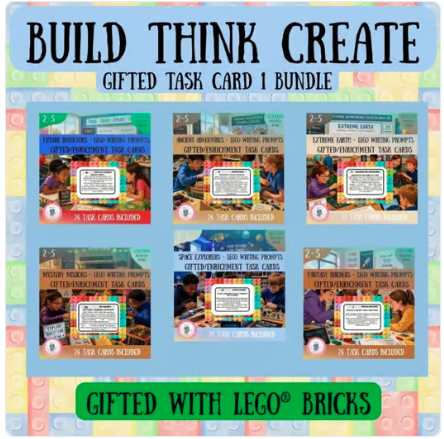
If you want the whole system at once, the Gifted Mega-Bundle includes all 14 sets — 312 cards total — for $46.00. I think of it as one complete gifted enrichment program you can pull from all year. GIFTED MEGA-BUNDLE ($46.00)]
Whether you grab one set or the whole bundle, I hope your early finishers finally have something that makes them lean in.
Pin It for Later
If this post gave you an idea for your own classroom, save it to Pinterest so you can find it again later! Just click the pin button on the image above. It’s the easiest way to build your own library of teaching ideas — and it helps other teachers find this too.


Leave a Reply