If you’ve ever watched a student’s face light up while building with LEGO bricks, you already know there’s something magical happening beyond the plastic pieces. LEGO storytelling — using bricks to build scenes, characters, and worlds that fuel narrative writing and oral storytelling — is one of the most engaging, low-prep tools a K-5 teacher can bring into the classroom. It’s hands-on, it’s differentiated by nature, and it turns even your most reluctant writers into eager storytellers.
Here are 10 ways to bring LEGO storytelling into your classroom, whatever grade you teach.
1. Build a Setting Before You Write One
Before students write a single sentence, have them build the setting of their story with LEGO bricks. Is it a castle? An underwater cave? A busy city street? Physically constructing the world first helps students generate sensory details they’ll use in their writing.
2. Create Character Profiles from Minifigures
Hand out LEGO minifigures (or let students build their own) and have them write character profiles: name, personality traits, goals, and fears. This works beautifully for teaching character development in narrative writing units.
3. Use Brick Builds as Story Starters
Place a small, unexpected LEGO scene on each table — a dragon guarding a tower, a spaceship crash-landed in a forest — and challenge students to write the story behind it. The visual prompt removes the “I don’t know what to write about” barrier instantly.
4. Retell Familiar Stories with Bricks
Have students rebuild a scene from a book you’re reading aloud, then narrate it back in their own words. This reinforces sequencing, comprehension, and retelling skills — especially powerful for K-2 classrooms.
5. Build the Problem and Solution
Story structure can be abstract for young learners. Have students physically build the “problem” scene and the “solution” scene side by side, then narrate the turning point in between. It makes plot structure tangible.
6. Collaborative Story Chains
In small groups, have one student build a scene and start a story aloud, then pass the bricks to the next student to add on and continue. This builds collaborative storytelling skills and keeps every student engaged and accountable.
7. LEGO Story Stop-Motion
For upper elementary students ready for a tech integration project, use a tablet or phone to take sequential photos of a LEGO scene as it changes, then stitch them into a simple stop-motion video with narration. It’s a fantastic project-based culmination of a writing unit.
8. Build Setting Changes to Teach Story Arcs
Have students build the beginning, middle, and end settings of their story using three small trays or mats. Seeing the physical progression helps them understand pacing and story arc in a way that outlining on paper sometimes doesn’t.
9. Vocabulary Builds
Give students a vocabulary word and have them build a scene that represents it, then explain their build using the word in context. This is a fun, memorable way to reinforce Tier 2 vocabulary within a storytelling framework.
10. Peer Storytelling Gallery Walk
After building, let students do a “gallery walk” where they visit each other’s LEGO scenes and orally share a brief story about what they see. This builds speaking and listening skills alongside narrative thinking, and it’s a great low-stakes way to practice public speaking.
Why LEGO Storytelling Works
LEGO storytelling taps into something every elementary teacher already knows: students think better with their hands. Building a scene activates spatial reasoning, sequencing, and imagination all at once, which means the writing that follows is richer and more detailed. It’s also naturally differentiated — a kindergartner and a fifth grader can both build a “problem and solution” scene, just at different levels of complexity, making it a genuinely inclusive strategy for mixed-ability classrooms.
Best of all, it doesn’t require anything fancy. A single bin of bricks, a few minifigures, and some imagination is enough to transform your writing block into something students actually look forward to.
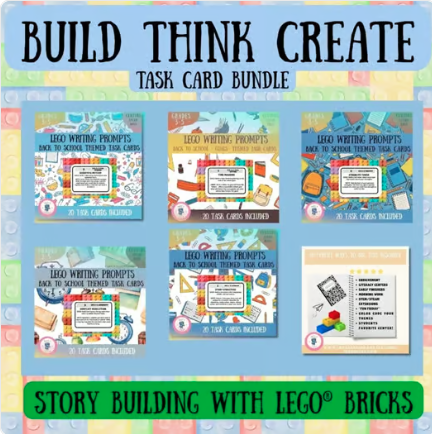
Ready-made LEGO storytelling resources, done for you: If you love these ideas but don’t have time to build the lesson plans, graphic organizers, and prompts from scratch, check out Build • Think • Create™ on Teachers Pay Teachers. It’s a full set of LEGO-based storytelling resources designed specifically for K-5 classrooms — ready to print, ready to teach, no prep required.


Leave a Reply