Ask any elementary teacher what the hardest part of writing workshop is, and many will say the same thing: the blank page. Students freeze. They stare. They write “I don’t know what to write about” and mean it. But hand that same student a bin of building blocks and ask them to create a scene, and something shifts. Suddenly they’re deep in a world of their own making — and the words start to follow.
There’s a simple but powerful idea behind this shift: building before writing improves creativity. Here’s why it works, and how you can use it in your K-5 classroom starting tomorrow.
Building Gives Students Something to Write About
Blank-page writing asks students to imagine and articulate at the same time — two demanding cognitive tasks happening simultaneously. Building removes one of those demands. When students physically construct a setting, character, or scene first, they’ve already done the imagining. Writing becomes description and narration of something that already exists in front of them, which is a far less intimidating task, especially for young or reluctant writers.
Hands-On Play Activates Divergent Thinking
Educational research on play-based learning consistently points to the same conclusion: open-ended, hands-on play encourages divergent thinking — the ability to generate multiple, original ideas rather than settling for the first obvious answer. When students build without a single “correct” outcome in mind, they naturally explore possibilities. That exploration carries directly into their writing, producing stories with more unexpected details, twists, and character choices.
Physical Building Supports Sequencing and Structure
Story structure — beginning, middle, end; problem and solution; rising action — can be an abstract concept for young learners. Building makes it concrete. When a student constructs the “before” and “after” of a story physically, they can see the structure, not just imagine it. This scaffolding makes it much easier for them to translate structure into written narrative, because they’ve already organized their thinking spatially before they had to organize it on paper.
It Lowers the Stakes for Reluctant Writers
For students who struggle with writing — whether due to fine motor challenges, language processing, or simple lack of confidence — building offers a low-stakes entry point. There’s no wrong way to build a spaceship or a castle. That freedom from “getting it wrong” carries over into the writing that follows: students who feel successful in the building phase tend to approach the writing phase with more confidence and willingness to take risks.
It Naturally Differentiates
A kindergartner and a fifth grader can both build a scene and tell a story about it — just at very different levels of complexity. This makes build-before-write strategies uniquely useful in mixed-ability classrooms. Every student can access the same activity and produce writing appropriate to their own level, without you needing to create separate assignments.
It Makes Revision Visual
One often-overlooked benefit: when students want to revise their story, they can revise their build first. Moving a piece, adding a character, or changing a setting detail gives them a tangible way to “see” a revision before committing it to words. This can make the often-dreaded revision process feel more like play and less like a chore.
Bringing It Into Your Classroom
You don’t need an elaborate setup to try this. Start small: give students five minutes to build a simple scene using any blocks or manipulatives you have on hand, then ask them to write three to five sentences about what’s happening in it. Over time, you can build up to full narrative units where building and writing are woven together at every stage — planning, drafting, and revising.
The core principle stays the same regardless of grade level or materials: when students build first, they write with more confidence, more detail, and more original thinking.
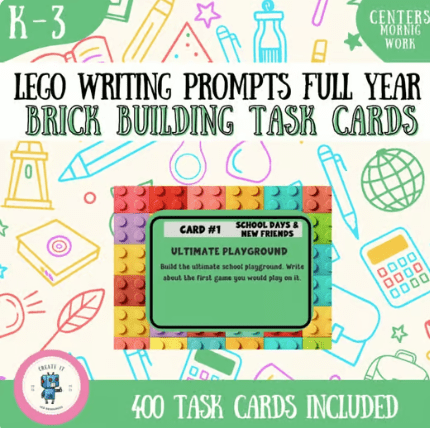
Want the building-to-writing structure done for you? Build • Think • Create™ on Teachers Pay Teachers takes the guesswork out of build-before-write instruction with ready-to-use lesson plans, graphic organizers, and prompts designed specifically for K-5 classrooms. No prep, just print and teach.


Leave a Reply